


Take one patient. Same anatomy, same tissue quality, same skin envelope, same 375 cc round implant. Hand the case to two experienced surgeons.
One places the implant in a dual-plane pocket, releases the inferior origin further, and accepts slightly more lower-pole stretch. The other stays subfascial, keeps the pocket tighter, and dresses the patient in a compressive garment for four weeks. At six months, the two results differ in projection, in upper-pole fill, and in the position of the new inframammary fold.
Both are good surgery. Neither is wrong. And this is the problem every simulation model in aesthetic medicine has to confront.
What “trained on thousands of cases” really means
When a simulation tool is built on a large, aggregated dataset, it learns the central tendency of that dataset. The output converges toward what happens on average across the surgeons, techniques, implant families, and patient populations represented in it.
That average is useful. It is also, strictly speaking, a result that nobody produces. It is a composite of subpectoral and prepectoral placements, of high-profile and moderate-profile implants, of patients with dense tissue and patients with attenuated tissue, of practices in different countries with different aesthetic conventions.
A surgeon looking at that output is being shown a result assembled from other people’s decisions. The closer the surgeon’s own practice sits to the middle of the distribution, the better it works. The more distinctive the technique, the worse the fit.
This is not a flaw introduced by carelessness. It is what generalization does. A model built to serve everyone reasonably well cannot simultaneously be exact for anyone in particular.
Where the variance actually comes from
The distance between a general model and a specific practice is not a single gap. It accumulates across several independent axes.
Pocket and plane. Subglandular, subfascial, dual-plane, full submuscular. Each produces a different soft tissue response to the same implant volume, and each surgeon has a preferred default plus a set of conditions for deviating from it.
Implant portfolio. A surgeon who works predominantly with one manufacturer’s cohesive gel range is producing a different family of results than one who alternates across three brands and four projection profiles. Shell behaviour, gel cohesivity, and base diameter conventions all differ.
Dissection habit. How far the inferior origin is released, how the fold is handled, how much undermining is accepted. These are the decisions surgeons describe as feel, and they are precisely the decisions that determine lower-pole shape.
Patient population. A practice in one region may see systematically different BMI ranges, tissue characteristics, and parity histories than a practice five hundred kilometres away. The anatomy entering the operating room is not randomly distributed.
Post-operative protocol. Garment regimes, massage instructions, activity restrictions, and follow-up intervals all shape the result the patient eventually sees, and they vary widely.
Each axis alone is a modest deviation from the mean. Stacked, they explain why an experienced surgeon can look at a generic simulation and say, correctly, that the result does not look like their work.
The consequence in the consultation room
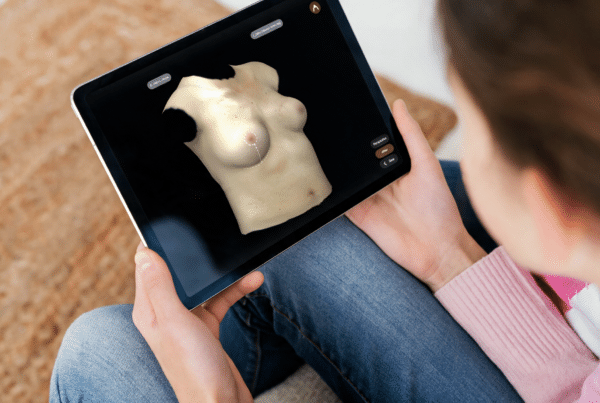
A simulation is not primarily a technical artefact. It is a communication instrument. Its job is to align what the patient expects with what the surgeon can deliver.
That alignment fails in two directions. If the simulation is more flattering than the surgeon’s typical result, the patient arrives at follow-up with a disappointment that was manufactured before the incision. If the simulation is more conservative, the surgeon undersells work they are perfectly capable of doing, and the patient goes elsewhere.
Both failures come from the same source. The model is answering a question about surgery in general, while the patient is asking a question about this surgeon.
What personalization has to mean
If the diagnosis is that variance across practices is structural, then the remedy cannot be more aggregated data. Adding cases to a general model makes the average more stable. It does not make it yours.
Personalization means something narrower and harder. It means a model whose behaviour has been adapted to the specific relationship between pre-operative anatomy, surgical decision, and observed result within a single practice. The physics does not change. The tissue mechanics do not change. What changes is which region of the possible outcome space the model treats as correct.
Practically, this requires three things a general dataset cannot supply. It requires paired cases from that practice, before and after, at a consistent interval. It requires the decisions attached to each case, including plane, implant reference, and any technique notes the surgeon considers material. And it requires enough consistency in how those cases are captured that the model is learning surgical signal rather than measurement noise.
That is a meaningful contribution to ask of a surgeon. It is also the only route to a simulation that reflects their hand rather than the field’s average hand.
The Research Partner Program
Arbrea Labs has opened a Research Partner Program for surgeons who want to build this rather than wait for it. Partners contribute cases and outcome data from their own practice, and in return receive the first version of Arbrea adapted to their technique, their preferred implant portfolio, and their patient population.
The premise is straightforward. The surgeons who define the standard of care in their own operating rooms should be the ones defining what a model considers a correct result.
Learn how the Research Partner Program works, and what participating involves





 English
  Portuguese
  Italian
  Spanish
  German
  Arabic
  French
  Korean
  Albanian
  Thai
Thai  Hindi
Hindi  Vietnamese
  Japanese