


Look closely at the letter A in our logo.
Most people see a letter. Some see a mountain, fair enough, we’re a Swiss company. But the shape was drawn as the profile of a breast.
It isn’t decoration. It’s a reminder of the problem we set out to solve, and of the patients who were the reason we started.
This is that story.
It started as a research problem
Arbrea Labs began inside the Computer Graphics Laboratory at ETH Zurich — an institution consistently ranked among the top 10 universities in the world — where our CEO Dr. Endri Dibra was completing a PhD on reconstructing digital human avatars from a single image. The work had roots in his earlier research at Disney Research, where the objective was cinematic: believable digital humans, generated at scale.
The medical question came from closer to home. A diagnosis of breast cancer in the family put him in proximity to something the research world rarely sees: the reality of mastectomy, and the fact that patients are routinely asked to make irreversible decisions about their own bodies while relying almost entirely on imagination.
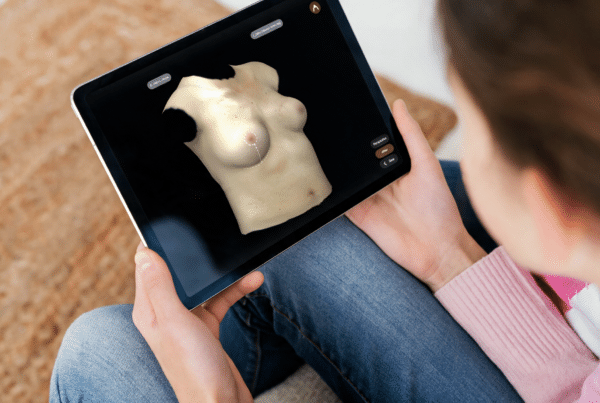
That set the direction. If an algorithm could infer three-dimensional shape from a flat photograph, it could do more than populate a film — it could give a surgeon and a patient a shared, realistic image of a result that did not yet exist. The entertainment problem and the medical problem turned out to be the same mathematics, pointed somewhere different.
The conversation that changed the product
A research result and a working product are separated by a distance that most academic projects never cross.
What got us across it wasn’t a breakthrough. It was a plastic surgeon who agreed to sit down with the founding team and say honestly what a surgeon actually needs in a consultation room — not what was technically impressive, but what was clinically useful.
That conversation reshaped the project. The goal stopped being a better reconstruction algorithm and became a tool a doctor would reach for on a Tuesday morning, with a nervous patient sitting across the desk. It’s a principle we’ve kept ever since: every module we’ve built since then started the same way, with surgeons telling us what was missing.
The prototype came out of those conversations. Arbrea Labs came out of the prototype.
The hardest thing in the human body to model
Here is the part nobody warned the team about.
The breast is one of the most technically difficult regions of the body to model. It’s soft tissue. It changes with posture, with gravity, with breathing. And critically, the training data didn’t exist — there was no large, structured dataset of three-dimensional breast anatomy waiting to be used.
Most teams would have stopped there. Ours took the harder route: if the real-world data doesn’t exist, generate it.
Using techniques from visual computing, we built realistic synthetic data — anatomically plausible, systematically varied, and large enough to train algorithms that generalize to real patients. That synthetic foundation is still the engine underneath the Arbrea app today.
The pilot launched in a remarkably short window. With it came a sentence that would have sounded absurd a decade earlier: there’s an app that lets a plastic surgeon pre-visualize breast surgery results.
What’s actually in the name
People ask us about the name more often than about the technology. It carries three meanings at once, and all of them were deliberate.
AR — augmented reality, the technology that lets a patient see a possible version of herself rendered on her own body.
Brea — from breast. Where the work began.
Arbëria — the ancient name of Albania, a nod to the roots of our co-founder. A company built in Switzerland, with an origin story that reaches further back.
And the color. Arbrea Purple was chosen for its association with cancer awareness — the visual language of the community whose experience set this project in motion. It follows us onto every screen, every slide, and every stand we’ve ever built.
Three meanings, one word, and a letter A shaped like the reason we exist.
Recognized where it counts
In 2024, Arbrea Labs earned the Innosuisse Certificate — a distinction awarded to Swiss companies demonstrating exceptional innovation and significant market potential.
We care about it for a specific reason. It isn’t a marketing award; it’s an assessment of substance, delivered by a country with an unusually low tolerance for overstatement. For a team that started with synthetic data and an unsolved imaging problem, it confirmed the path was the right one.
From breast, to face, to body — and to the patient
The breast module was the beginning, not the destination.
Surgeons who adopted Arbrea for breast consultations kept asking the same question: can it do this for the rest of my practice? It could — and so the platform grew, in the order our users asked for.
- Face — for rhinoplasty, fillers, and facial aesthetics, applying the same simulation logic to a far more expressive anatomy.
- Body — for liposuction, abdominoplasty, and body contouring.
- myArbrea — the patient-branded app that carries your practice’s identity into your patient’s pocket, keeping the connection alive between consultation and decision.
That last one matters more than it first appears. The consultation is no longer a single appointment. It’s a conversation that continues at home, at night, over weeks — usually without you in the room. myArbrea puts your practice in that conversation, under your name.
More than 60 countries, one community
Today, Arbrea Labs works with plastic surgeons and aesthetic doctors in more than 60 countries, and holds partnerships with industry leaders including Mentor (Johnson & Johnson) — placing our simulation technology alongside one of the most established names in breast implants.
But the number we think about isn’t 60. It’s the number of consultations where a patient stopped guessing and started understanding. Where hesitation turned into an informed decision. Where a surgeon spent less time managing expectations and more time practicing medicine.
Every surgeon who uses Arbrea is part of a story that began with a research lab in Zurich, a problem everyone else considered unsolvable, and the refusal to accept that a patient should have to imagine her own outcome.
The A in our logo is a breast in profile. Now you know why.
And if you’re already part of this community that shape belongs to your story too.
Curious to see what your consultations could look like? Discover the Arbrea Suite or explore the breast module.




 English
  Portuguese
  Italian
  Spanish
  German
  Arabic
  French
  Korean
  Albanian
  Thai
Thai  Hindi
Hindi  Vietnamese
  Japanese