


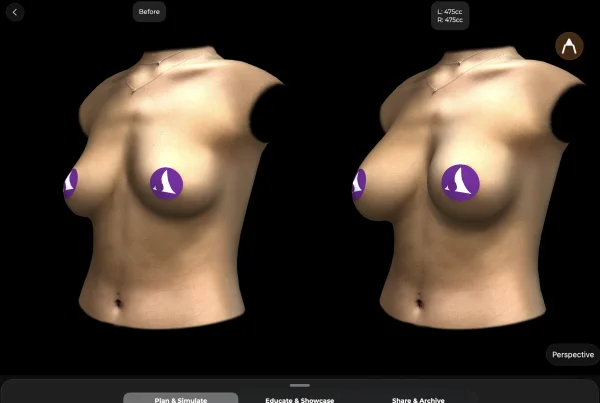
A simulation shown in a consultation makes an implicit promise. The patient understands it as: this is roughly what I will look like when this surgeon operates on me.
Patients are not being naive. That is a reasonable reading of what a personalized 3D preview appears to offer. The question is whether the tool producing it was built to answer that question or a different one.
A general model answers a different one. It answers what this anatomy plus this implant tends to produce across surgical practice broadly. The patient hears a specific promise, and the software delivered a population estimate. Most of the time the gap is small enough that nobody notices. When it is not, the cost lands in follow-up, in revision discussions, and in reviews.
Four things that change
1. Expectation alignment stops being a negotiation
The standard workaround for a simulation that does not match a surgeon’s output is verbal correction. The surgeon shows the preview and then talks the patient down or up from it. Slightly less projection than that. A bit more upper-pole fill in my hands.
This works, but it spends credibility. The patient has just been shown an image and then told the image is not quite right, which invites the reasonable question of why they were shown it.
When the simulation already sits inside the surgeon’s own result distribution, the conversation moves from correcting the tool to discussing the plan. The image becomes something the surgeon and patient reason with together instead of something the surgeon has to caveat.
2. Implant selection becomes comparative rather than theoretical
Most patients cannot meaningfully evaluate a choice between a moderate-plus and a high-profile implant in the abstract. Diameter and projection in millimetres do not translate into a mental image.
A model calibrated to the implants a surgeon actually uses can show the difference on that patient’s anatomy, within that surgeon’s technique. The comparison becomes concrete without becoming speculative, because both options being compared are options the surgeon genuinely performs. A general model can also show two options, but it shows them as the field would produce them, which quietly reintroduces the mismatch.
3. Informed consent gets better documentation
Consent is stronger when there is evidence that expectations were discussed and set. A simulation record attached to the case file is exactly that evidence.
The evidentiary value depends on the simulation being defensible. A preview generated by a model calibrated to the surgeon’s own outcomes is a documented representation of what that surgeon reasonably expected to achieve. A preview generated by a general model is a representation of what the field on average achieves, which is a weaker thing to have shown a patient and called their result.
This is not a legal argument, and it should not be presented to patients as one. It is a note about the quality of the record.
4. The second-opinion dynamic inverts
Patients shop. They consult two or three surgeons and compare. When every surgeon shows a preview from the same general model, the previews look broadly alike, and the patient falls back on price, availability, and rapport.
When a preview is calibrated to the individual surgeon, the differences between practices become visible in the one place patients can actually perceive them. A surgeon whose technique produces a distinctive result now has a way to show it before the patient has committed to anything. For surgeons whose main competitive asset is their actual work, this is the first tool that makes that asset legible during the decision.
What personalization does not fix
Some caution is warranted, and surgeons will supply it themselves if the copy does not.
A calibrated model does not make the simulation a prediction. Tissue response varies between patients in ways no model resolves, healing is individual, and no preview should be presented as a commitment. The framing that holds up is that the simulation shows a realistic target consistent with the surgeon’s own results, and that individual outcomes vary.
Personalization also does not repair unrealistic patient goals. It arguably makes them easier to identify. A patient who rejects an accurate representation of what this surgeon achieves is telling the surgeon something useful during the consultation rather than after the operation.
And it does not remove the surgeon from the conversation. The simulation is a shared reference point. The judgement about whether the plan is appropriate for that patient remains entirely clinical.
The practical position
The value of a simulation in a consultation is proportional to how closely it corresponds to what the surgeon will actually do. That correspondence is not a matter of rendering quality or interface polish. It is a matter of what the model was calibrated against.
The Research Partner Program exists so that surgeons can determine that answer for themselves. Partners contribute cases and outcome data from their own practice and receive the first version of Arbrea adapted to their technique, their implant portfolio, and their patient population.






 English
 Portuguese
 Italian
 Spanish
 German
 Arabic
 French
 Korean
 Albanian
 Thai
 Hindi
 Vietnamese
 Japanese