

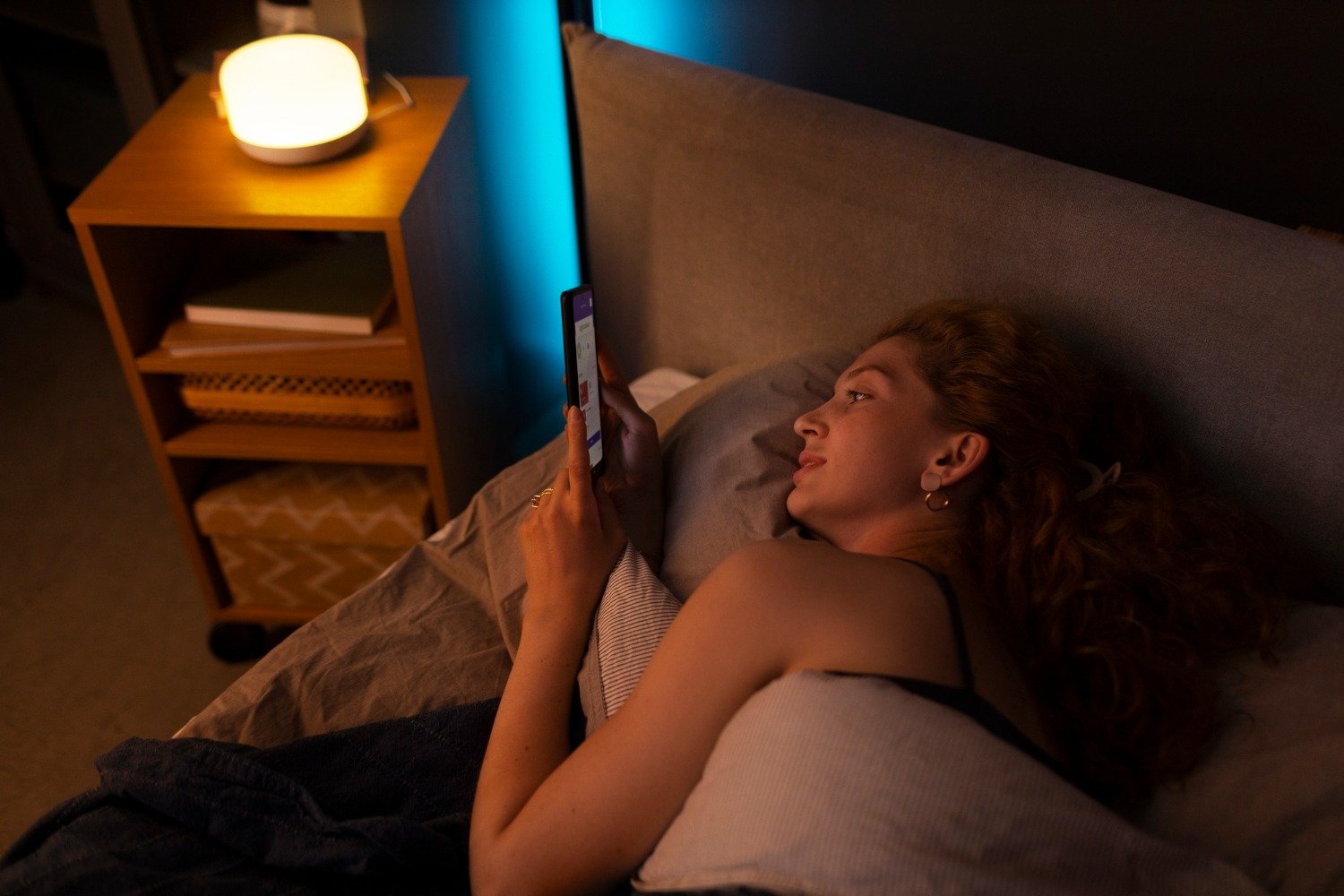
Your clinic closes at 6PM. Your patients’ decision-making process doesn’t
Some of the most important decisions in aesthetic medicine happen far away from the consultation room. A patient is lying in bed scrolling through Instagram. They notice their profile in a photo from the weekend. They look in the bathroom mirror from a different angle. They talk to their partner about a procedure they have been considering for months.
Then, at 11PM, they search:
“jawline filler near me.”
From a behavioral science and neuromarketing perspective, this moment is particularly interesting because the patient is not simply searching for information. Several psychological mechanisms can converge at once: attention, emotional salience, self-relevance, visualization, and anticipation of a future self. For aesthetic practices, understanding these mechanisms changes the question from:
“How do we generate more leads?”
to:
“How do we help patients move forward when their interest is already at its highest?”
Why aesthetic decisions often begin in private moments
It is tempting to explain late-night behavior by saying that people simply become more impulsive as the day progresses. The science is more nuanced.
A stronger way to understand these moments comes from the concepts of salience and self-relevance. Aesthetic concerns are inherently personal. A photograph, mirror reflection, upcoming wedding, birthday, vacation, or conversation can suddenly make something that has existed in the background feel immediately relevant.
People do not evaluate every possible decision continuously. Attention is selective. When a concern becomes salient, it can temporarily occupy a much larger share of our attention.
For aesthetic practices, this creates what we might call a high-intent moment: the distance between thinking about something and taking the next step becomes unusually small.
And these moments do not necessarily happen between 9AM and 6PM.
They happen when the patient is thinking about themselves. The brain doesn’t experience every future equally
There is another psychological mechanism that is particularly relevant to aesthetic medicine: future self-continuity. Research by Hal Hershfield and colleagues has explored how connected people feel to their future selves.
The basic idea is surprisingly powerful. We don’t always experience our future self as completely us. When the person we might become feels distant or abstract, decisions benefiting that future person can feel less compelling today.
In one neuroimaging study, Hershfield, Wimmer, and Knutson used fMRI to examine neural responses when participants thought about their present and future selves. Individual differences in neural responses to the current versus future self were associated with differences in temporal discounting — our tendency to value present and future rewards differently.
Although this research focused on financial decision-making rather than aesthetic medicine, it provides an interesting insight: How vividly and closely we relate to our future self can influence present-day decisions.
The brain doesn’t experience every future equally
There is another psychological mechanism that is particularly relevant to aesthetic medicine: future self-continuity.
Research by Hal Hershfield and colleagues has explored how connected people feel to their future selves.
The basic idea is surprisingly powerful.
We don’t always experience our future self as completely us. When the person we might become feels distant or abstract, decisions benefiting that future person can feel less compelling today.
In one neuroimaging study, Hershfield, Wimmer, and Knutson used fMRI to examine neural responses when participants thought about their present and future selves. Individual differences in neural responses to the current versus future self were associated with differences in temporal discounting — our tendency to value present and future rewards differently.
Although this research focused on financial decision-making rather than aesthetic medicine, it provides an interesting insight:
How vividly and closely we relate to our future self can influence present-day decisions.


From “What would I look like?” to “That could be me”
This is where visualization becomes particularly interesting for aesthetic medicine. Consider the difference between two experiences. In the first, a patient is told:
“This treatment could improve the projection of your chin and create more balance in your profile.”
The patient has to construct the outcome mentally.In the second, the patient sees a personalized simulation representing what that potential change might look like. The information has moved from verbal description to visual self-representation. That distinction matters.
1. Images are unusually memorable
One of the most established findings in cognitive psychology is the picture superiority effect.
Classic experiments by Allan Paivio and Kalman Csapo demonstrated that, under many conditions, pictures are remembered better than equivalent verbal information. More recent research continues to investigate and support the existence of this effect.
For aesthetic medicine, the relevance is clear. Patients are making an inherently visual decision. Showing a patient a visual representation therefore provides something another paragraph explaining a procedure cannot easily reproduce: a concrete image to remember.
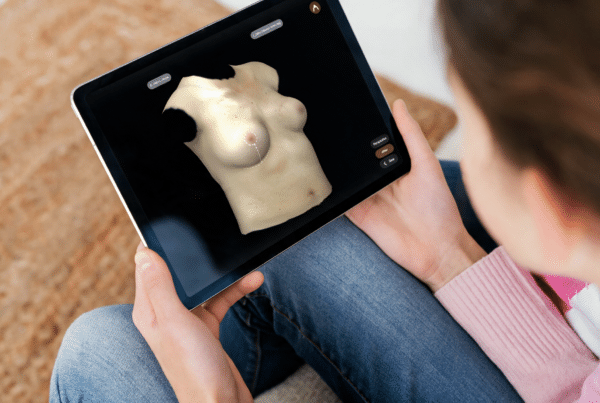
This is one of the principles behind Arbrea’s AR and 3D simulation technology, which allows aesthetic professionals to introduce visualization directly into the patient journey.
2. Visualization reduces abstraction
Before simulation, a patient’s desired outcome exists primarily in imagination:
“Maybe my profile could look more balanced.”
“Maybe this procedure would suit me.”
“Maybe I would feel more confident.”
These are abstract propositions. A personalized visualization can convert some of that abstraction into something perceptually concrete. The psychological shift is subtle but important:
“What could this procedure do?”
becomes:
“What could this look like on me?”
That is a fundamentally more self-relevant question.
For procedures such as breast augmentation, reduction, or mastopexy, for example, an AI breast simulator can help bring visualization into the consultation and communication process.
3. The future self becomes easier to imagine
This brings us back to Hershfield’s research. In a particularly interesting series of experiments, Hershfield and colleagues allowed participants to interact with realistic, age-progressed digital renderings of themselves.
The researchers were not studying cosmetic procedures. They were studying financial decision-making and saving behavior. That distinction is important. However, participants who interacted with representations of their future selves showed an increased tendency to choose later financial rewards over immediate ones.
The researchers proposed that making the future self more vivid could strengthen the connection people feel with that future version of themselves. The parallel with aesthetic visualization is conceptually interesting.
A personalized aesthetic simulation gives patients something their imagination alone cannot provide as precisely: a visual reference for a possible future version of themselves.
This does not mean neuroscience proves that an aesthetic simulation will make someone book a procedure. It means research gives us a framework for understanding why making a future outcome visual, personal, and concrete can matter psychologically.
Why immediate interaction matters
Now return to the patient searching at 11PM. They are interested enough to visit the practice’s website.
What happens next? For many practices, the journey ends with:
- A phone number that won’t be answered until morning
- A generic contact form
- A WhatsApp message waiting for a reply
- A “request a consultation” button
Each additional step can introduce friction between motivation and action. The patient may still contact the practice tomorrow. But tomorrow they will be in a different context, with different priorities competing for their attention.
This is why an interactive digital patient journey should not simply be understood as a convenience feature. It gives patients the opportunity to explore their interest while that interest is currently salient.
How Arbrea’s AI Simulator changes that moment
This is where myArbrea fits into the patient journey. Instead of asking patients to preserve their motivation until the practice reopens, practices can give them something meaningful to do while their curiosity is active. With myArbrea simulation experience, a patient can:
- Create a personalized visualization
- Explore potential aesthetic outcomes
- Consider the visualization privately and at their own pace
- Discuss it with a partner or friend
- Submit their information
- Move toward a consultation
The technology therefore does more than simply digitize part of the patient journey. It transforms a passive browsing moment into an interactive visualization experience. And psychologically, that is a very different experience.
The neuromarketing principle: make the future concrete
Good neuromarketing is not about finding a secret “buy button” in the brain. There isn’t one. Instead, it is about understanding how attention, memory, emotion, self-relevance, visualization, and decision-making interact. For aesthetic medicine, perhaps the most useful principle is remarkably simple:
People find it easier to evaluate a future they can visualize.
A patient may spend months thinking: “Maybe som eday.”
Then something makes the desire salient.
They start searching.
They see a personalized representation.
The abstract possibility becomes more concrete.
And suddenly the next step — a consultation — may feel much closer.
The role of technology isn’t to manufacture that motivation.
The motivation already exists. The opportunity for the practice is to be present when it becomes actionable.
From lead generation to intent capture
This changes how aesthetic practices can think about digital patient acquisition. The traditional question is:
“How can we generate more leads?”
Behavioral science suggests another:
“What happens at the exact moment a patient becomes motivated enough to imagine change?”
Those moments might happen after seeing a photograph. Before a wedding. After a birthday. While scrolling Instagram. Or at 11PM in front of a mirror.
Practices cannot control when those moments happen. But they can decide whether the patient’s journey stops there — or continues.
Arbrea’s AI and 3D simulation technology helps bring visualization into that journey, turning curiosity into a more concrete and personalized exploration of what may be possible. Because your clinic may close for the night. Your patient’s imagination doesn’t.

Scientific References & Further Reading
Ersner-Hershfield, H., Wimmer, G. E., & Knutson, B. (2009).
Saving for the future self: Neural measures of future self-continuity predict temporal discounting. Social Cognitive and Affective Neuroscience, 4(1), 85–92.
https://doi.org/10.1093/scan/nsn042
PubMed: https://pubmed.ncbi.nlm.nih.gov/19047075/
Full text: https://pmc.ncbi.nlm.nih.gov/articles/PMC2656877/
Hershfield, H. E., Goldstein, D. G., Sharpe, W. F., Fox, J., Yeykelis, L., Carstensen, L. L., & Bailenson, J. N. (2011).
Increasing Saving Behavior Through Age-Progressed Renderings of the Future Self. Journal of Marketing Research, 48, S23–S37.
https://doi.org/10.1509/jmkr.48.SPL.S23
PubMed: https://pubmed.ncbi.nlm.nih.gov/24634544/
Full text: https://pmc.ncbi.nlm.nih.gov/articles/PMC3949005/
Paivio, A., & Csapo, K. (1973).
Picture superiority in free recall: Imagery or dual coding? Cognitive Psychology, 5(2), 176–206.
https://doi.org/10.1016/0010-0285(73)90032-7
Publisher: https://www.sciencedirect.com/science/article/abs/pii/0010028573900327
Ensor, T. M., Bancroft, T. D., & Hockley, W. E. (2019).
Listening to the Picture-Superiority Effect. Experimental Psychology, 66(2), 134–153.
https://doi.org/10.1027/1618-3169/a000437
PubMed: https://pubmed.ncbi.nlm.nih.gov/30895914/




 English
  Portuguese
  Italian
  Spanish
  German
  Arabic
  French
  Korean
  Albanian
  Thai
Thai  Hindi
Hindi  Vietnamese
  Japanese