


Not every insight worth acting on comes from a single market report. Some of the most useful signals about where aesthetic surgery consultations are heading come from decision science, consumer psychology, and technology adoption research that wasn’t even conducted specifically about plastic surgery — but applies directly to it. Here are five patterns worth understanding, and what each one implies for how you run consultations.
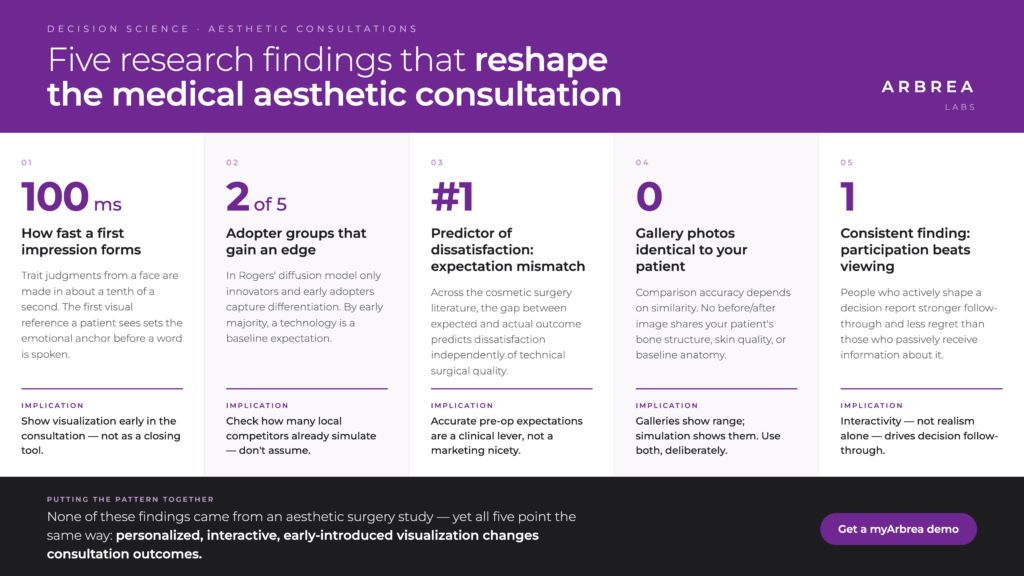
1. 100 milliseconds — how fast a first impression forms
Willis and Todorov’s widely cited social cognition research found that people form trait judgments from a face in as little as 100 milliseconds of exposure. Applied to consultations: the quality of the very first visual reference a patient sees — sharp and personalized versus vague and generic — sets an emotional anchor almost instantly, well before any verbal explanation has a chance to shape the conversation.
Implication: Introduce Arbrea visualization early in the consultation, not as a closing tool.
2. Five adopter categories — and only two of them capture a marketing advantage
Everett Rogers’ diffusion of innovations model splits technology adoption into innovators, early adopters, early majority, late majority, and laggards. Historically, across every industry this framework has been applied to, only the first two categories capture meaningful differentiation value from being early — by the time a technology reaches “early majority” adoption, it has typically become a baseline expectation rather than a competitive edge.
Implication: Whether 3D simulation technology is a differentiator or a requirement in your specific local market depends entirely on how many of your competitors have already adopted it — worth actually checking, not assuming.
3. One dominant predictor of dissatisfaction — expectation mismatch
Across the cosmetic surgery psychology literature (Sarwer & Crerand; Honigman, Phillips & Castle, among others), mismatch between expected and actual outcome is repeatedly identified as one of the strongest predictors of patient dissatisfaction — independent of technical surgical quality. This single finding is arguably the most important one in this entire list, because it means satisfaction is, in part, a communication outcome, not only a surgical outcome.
Implication: Any tool that improves the accuracy of pre-operative expectations is not just a marketing nicety — it is functioning as a genuine clinical-outcome lever.
 4. Zero — the number of comparison photos that are anatomically identical to your patient
 4. Zero — the number of comparison photos that are anatomically identical to your patient
Social comparison research (Festinger’s foundational work and its many extensions) establishes that comparison accuracy depends on similarity between the person and the comparison target. No before/after gallery photo, however impressive, has your specific patient’s bone structure, skin quality, or baseline anatomy. That’s not a critique of before/after galleries — they remain useful for demonstrating range and style — but it does mean they are structurally incapable of solving the personalization problem on their own.
Implication: Personalized, patient-specific simulation and general-portfolio galleries solve two different problems; strong consultations use both, deliberately.
5. One consistent finding — active participation beats passive viewing
Commitment and consistency research in behavioral psychology (Cialdini and the broader decision-ownership literature) consistently finds that people who actively participate in shaping a decision — rather than passively receiving information about it — report stronger follow-through and lower post-decision regret. An interactive 3D simulation session, where the patient adjusts and explores their own avatar, is a participation format; a static image or verbal description is not.
Implication: Interactivity, not just visual realism, is the feature most closely tied to decision follow-through.
Putting the Pattern Together
None of these five findings were discovered in an aesthetic surgery context specifically — they come from decision science, social cognition, and consumer psychology research spanning decades. What’s notable is how directly they all point toward the same operational conclusion: personalized, interactive, early-introduced visualization changes consultation outcomes, not because it’s a flashy add-on, but because it addresses well-documented mechanisms of human decision-making.
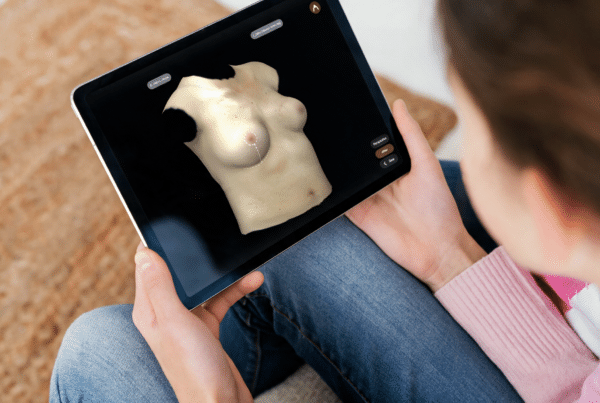
This is the underlying logic behind myArbrea: an AI-powered 3D avatar generated from consultation imaging that patients can interact with directly, addressing the personalization, interactivity, and expectation-calibration factors that the research above consistently identifies as decision-relevant.
The research points one direction. See what it looks like in practice.
Explore how myArbrea’s AI-powered 3D simulation puts these decision-science principles to work in your consultations. [Get a myArbrea demo]
References
- Willis, J., & Todorov, A. (2006). First Impressions: Making Up Your Mind After a 100-Ms Exposure to a Face. Psychological Science, 17(7), 592–598.
- Rogers, E. M. (2003). Diffusion of Innovations (5th ed.). Free Press.
- Sarwer, D. B., & Crerand, C. E. (2004). Body Image and Cosmetic Medical Treatments. Body Image, 1(1), 99–111.
- Honigman, R. J., Phillips, K. A., & Castle, D. J. (2004). A Review of Psychosocial Outcomes for Patients Seeking Cosmetic Surgery. Plastic and Reconstructive Surgery, 113(4), 1229–1237.
- Festinger, L. (1954). A Theory of Social Comparison Processes. Human Relations, 7(2), 117–140.
- Cialdini, R. B. (1984). Influence: The Psychology of Persuasion. William Morrow.






 English
  Portuguese
  Italian
  Spanish
  German
  Arabic
  French
  Korean
  Albanian
  Thai
Thai  Hindi
Hindi  Vietnamese
  Japanese