

The average aesthetic patient today has already Googled their procedure, watched a dozen videos, and quite possibly run their face through an AI tool before booking a consultation. They’re informed. The question is whether what they think they know is accurate.
A convincing image isn’t the same as an accurate one
Generative AI tools have made it trivially easy to produce a “transformed” version of someone’s face. Upload a photo, pick a filter or prompt, get a result in seconds. The images often look polished and realistic. But nobody built these tools for medical consultations, they built them to produce visually satisfying outputs, and they’re quite good at it.
What they’re not good at is anatomy.
They shift proportions in ways no procedure could replicate. They smooth over subtle structural details. The image reflects what the algorithm found aesthetically coherent, not what a surgeon can responsibly achieve. And because it looks real, patients rarely question it. That gap, between the image on their phone and what’s surgically possible, is where consultations start to break down.
The longer consult, the harder conversation
When a patient arrives with a reference image from a consumer AI tool, the surgeon’s job quietly doubles. There’s the clinical discussion, and then there’s the expectation reset that has to happen first.
That’s not a patient’s fault. They used the tools available to them. But it exposes a real gap in how practices deploy visualization technology. Showing someone a possible outcome should make the conversation easier. When done poorly, it does the opposite, it hands the patient a version of the future they’ve already attached to, one that was never grounded in reality.
What changes when surgeons have the right tool
There’s a version of the consultation most surgeons know is possible but rarely get to have, one where the patient already understands the realistic range of outcomes before the clinical explanation begins. Good visualization technology makes that version more likely.
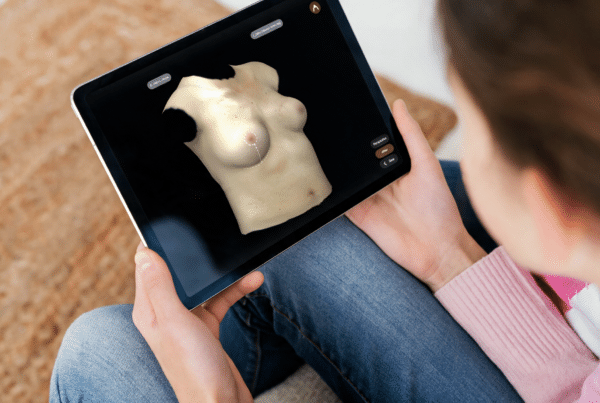
When a surgeon shows a simulation grounded in the patient’s actual anatomy, the conversation shifts. It stops being about managing disappointment and starts being about real choices, which approach, which tradeoff, what matters most to this patient. The surgeon spends less time on damage control and more time on the work that actually requires their expertise.
It also changes what patients carry out of the room. A patient who has seen a realistic, personalized simulation understands what they agreed to in a way a verbal explanation rarely achieves. That clarity reduces pre-procedure anxiety. It also tends to produce better outcomes, because the patient walked in with correctly set expectations.
The tool a practice uses says something about the practice
Patients notice more than surgeons sometimes realize. The technology in a consultation room isn’t just a clinical aid, it’s a signal. It tells a patient how seriously the practice takes their experience, and how much thought went into the process beyond the procedure itself.
A practice that hands a patient a consumer AI result communicates, intentionally or not, that the visual part of the conversation is an afterthought. A practice that uses clinically grounded simulation technology communicates something different: accuracy matters here, this patient’s anatomy matters, and the goal is a real outcome, not an impressive brochure.
In a field where trust drives everything and word of mouth still brings in most referrals, that signal carries weight. Patients talk. And increasingly, what they talk about isn’t just the result, it’s how the practice treated them while they were deciding.
What clinical visualization actually requires
Patients want to see potential outcomes, not just imagine them. That’s completely reasonable. The real question is whether the visualization serves entertainment or clinical communication. Those are two very different briefs.
At Arbrea Labs, the technology serves the second one. The goal isn’t to generate the most appealing version of a patient’s face, it’s to simulate realistic outcomes based on their actual anatomy. That distinction changes what the consultation can be. Instead of walking back expectations, the surgeon and patient look at the same realistic picture and actually talk about it.
Where this is going
Patients are going to keep using AI. They’ll keep researching, experimenting with tools, and arriving at consultations with more information, and more preconceptions, than before. That’s not going to reverse.
The practices that handle this well won’t push back against it. They’ll meet patients where they already are, with tools accurate enough to be clinically useful and clear enough to build real trust. The consultation doesn’t start when the patient sits down. For many patients, it started weeks earlier, the moment they first tried to picture what was possible.
Arbrea Labs exists to close that gap properly. Not to make AI visualization flashier, but to make it useful inside a real consultation, grounded in anatomy, honest about limitations, designed to support the conversation rather than derail it. There’s a meaningful difference between a tool that excites patients and one that helps them decide with confidence. That difference rarely shows up in a demo. It shows up six months later, when the patient feels the outcome matched what they understood was possible.






 English
  Portuguese
  Italian
  Spanish
  German
  Arabic
  French
  Korean
  Albanian
  Thai
Thai  Hindi
Hindi  Vietnamese
  Japanese