

Why post-op data matters in aesthetic surgery
In medical imaging research, pre-op and post-op scans are most valuable as a pair. First, the pre-op planning scan shows what was intended. Then, the post-op scan shows what was achieved. Collected across many patients, these before-and-after pairs therefore become a catalogue of what each surgical plan leads to.
Researchers align the two images and compare them to measure exactly what changed. In this way, a single surgical plan becomes clinical evidence that improves the next one.
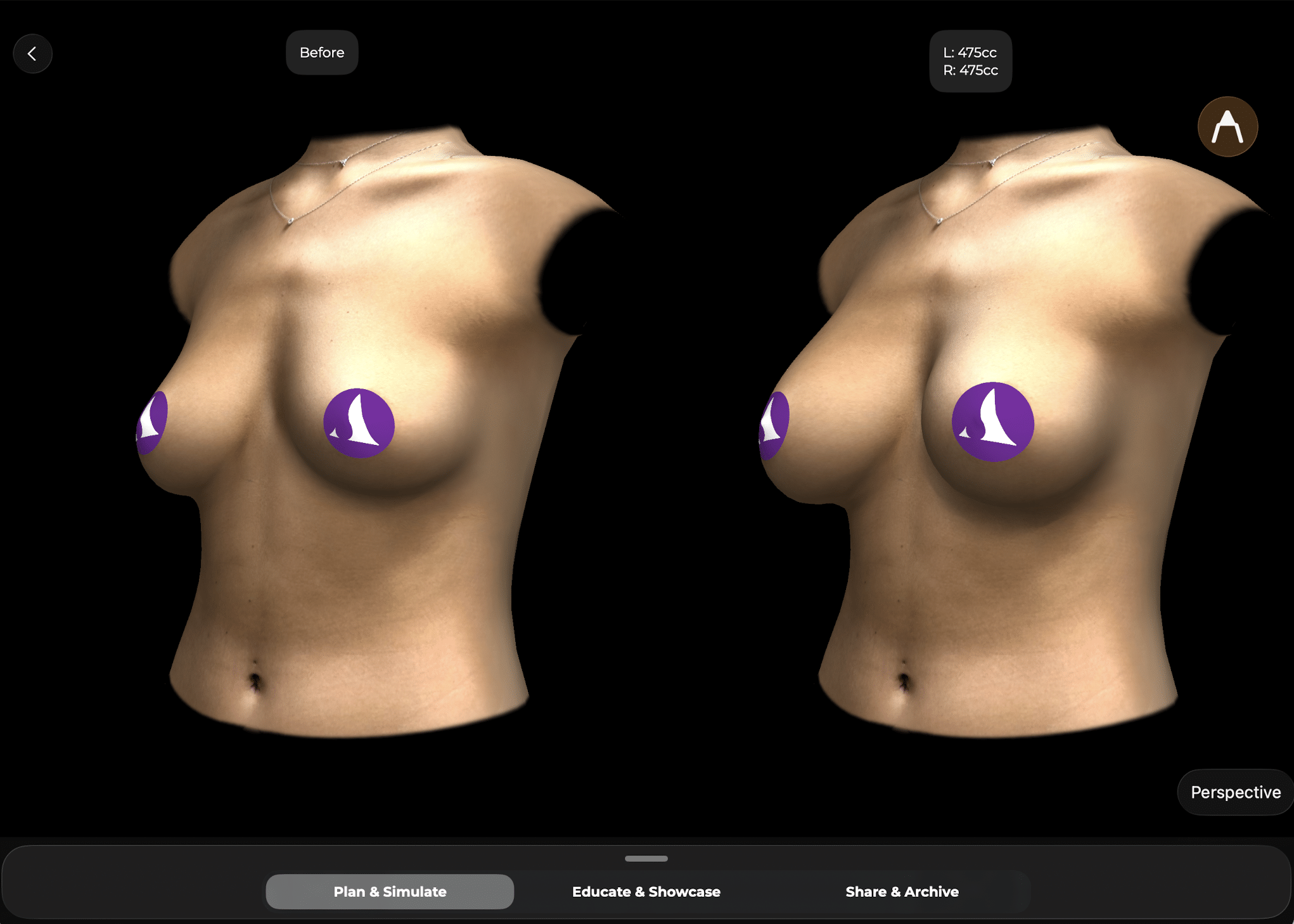
Aesthetic surgery works the same way. In fact, a 3D simulation of breast, face or body surgery is a plan. However, only the real post-op result turns that plan into knowledge. For this reason, connecting simulations with real surgical outcomes sits behind every Arbrea simulation. Here is what recent studies show about why post-op data matters so much.
How real post-op results make 3D simulations even more accurate
3D simulation has become one of the most valuable tools in aesthetic consultations. For example, it helps plastic surgeons plan procedures. It also helps patients see realistic before-and-after results before they decide.
Research also supports this. A 2026 systematic review in Plastic and Reconstructive Surgery Global Open looked at studies comparing 3D surgical simulations with real outcomes. This is the open-access journal of the American Society of Plastic Surgeons. For breast augmentation, high simulation accuracy has been reported across several 3D simulation software programs. In addition, the review describes 3D simulation as a significant step forward in aesthetic surgery.
This is where post-op data makes the difference. When a clinic’s Arbrea simulation is compared with the healed result, it confirms what the simulation already predicts well. It also shows where the simulation can be fine-tuned further. In addition, it shows how each implant in Arbrea’s implant catalogue performs in real patients. In short, Arbrea’s breast, face and body simulations keep improving not from more plans, but from more real results.
Before you measure change, measure “no change”
Imaging research has a simple rule: before claiming a method improved anything, first measure how similar the images already were with no correction at all. Skip that step and the method gets credit it never earned.
Before-and-after photos have the same trap. When lighting, camera distance or patient pose change between sessions, the photos can show a difference the surgery did not cause, or hide one it did.
Timing matters just as much. A 2025 MRI study in Plastic and Reconstructive Surgery followed patients who had breast augmentation with fat grafting for up to three years. The grafted fat volume only reached a steady state about 253 days after surgery, with about 46% of it retained. For this procedure, a photo at two weeks and one at eight months tell two very different stories. The practical point applies to any procedure: same setup every time, and always record the date.
The missing half
In research, the hardest part is rarely the analysis. It is getting complete data in the first place. Aesthetic medicine has the same problem, even in the best systems.
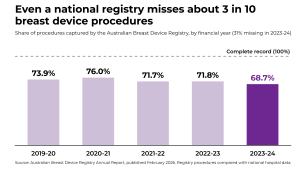
Australia runs a national breast device registry with an opt-out model, and only 1% of patients opt out. Yet its latest annual report, published in 2026, shows it captured about 69% of procedures in 2023-24, down from about 74% in 2019-20. The registry notes that part of the latest dip may be late data entry, but the gap has not closed in any recent year.
Body contouring shows the same gap. A 2026 study in Frontiers in Surgery on combined abdominoplasty and liposuction reported good early results, but the authors note that, without long-term outcome assessment, they cannot judge how well those results last.
If a national registry with almost no opt-outs still misses this much, a single clinic’s follow-up records will have gaps too. The takeaway is simple: post-op data only gets collected when it is easy and part of everyday practice.
Why one clinic’s data is not enough
Every patient’s anatomy is different. Because of this, AI models need many varied real cases. The more varied those cases are, the better a model can adapt its predictions to each patient.
However, individual practices cannot solve this alone. According to the Australian registry, 86% of participating clinicians perform 50 or fewer breast device procedures a year. As a result, any one clinician’s data can only show so much. The answer is not a smarter model. Instead, it is more real outcomes, documented across many clinics and many patients.
Closing the loop with the Arbrea Research Partner Program
This is why Arbrea created the Arbrea Research Partner Program (ARPP). A simulation is only as good as the real cases it has learned from, and ARPP gives clinics a simple way to contribute the other half of the picture: what actually happened after surgery. Together, these cases build a growing catalogue of real before-and-after results.
Every contributed case pairs an intention with an outcome. When a saved Arbrea simulation sits next to the healed result, the comparison shows exactly how close the prediction came and where it can be refined even further. 3D scans of the treated area add depth that photos alone cannot, and each clinic’s technique, choices from Arbrea’s implant catalogue and patient population become part of what the models learn from. A quarterly Data Priority List shows clinics where their cases are worth the most. Over time, Arbrea’s breast, face and body predictions move closer to the results each clinic actually delivers.
References
Atiyeh et al., systematic review, 2026 (breast, face, body). Only 17 clinical studies have checked a 3D simulation against the real outcome: 12 for breast, 5 for rhinoplasty and none for body procedures. Published in PRS Global Open.
Ørholt et al., 3-year MRI study, 2025 (breast). After breast augmentation with fat grafting, the grafted fat volume only became stable after about 253 days, with 46% retained. Published in Plastic and Reconstructive Surgery.
Abdominoplasty with liposuction, 2026 (body). The authors note that without long-term outcome data, they cannot judge how well results last. Published in Frontiers in Surgery.
Australian Breast Device Registry report, 2026 (breast). The registry captured about 69% of procedures in 2023-24, and 86% of participating clinicians perform 50 or fewer breast device procedures a year. Available as the ABDR Annual Report.






 English
 Portuguese
 Italian
 Spanish
 German
 Arabic
 French
 Korean
 Albanian
 Thai
 Hindi
 Vietnamese
 Japanese