


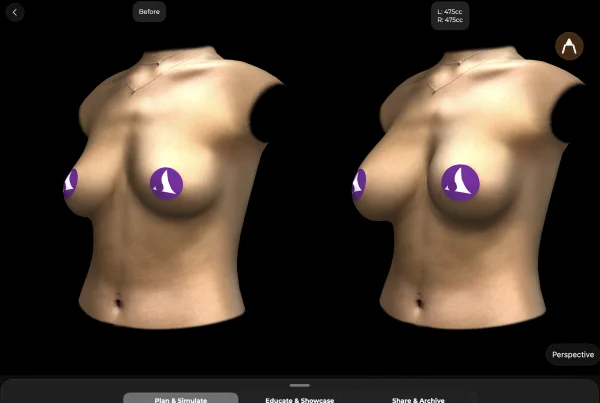
A new clinical study uses Arbrea Breast 3D to objectively track how five different breast implant types behave over 12 months. Published in the Aesthetic Surgery Journal, this peer-reviewed prospective research is the most detailed measurement-based comparison of implant stability to date.
Why This Study Matters
Surgeons choosing a breast implant weigh many factors, including shape, volume, gel firmness, and surface texture. However, long-term objective data on how those choices actually play out in real patients has been limited. Much of the available evidence relies on subjective assessment or short follow-up periods, leaving surgeons without a reliable picture of how implants behave over time.
Dr. Giovanni Bistoni, Dr. Pietro Luciano Serra, and Dr. Melba Lattanzi set out to change that. Their prospective study, published in the Aesthetic Surgery Journal (Volume 46, Issue 7, 2026), placed Arbrea at the center of the methodology.
Study Overview: 106 Patients, 5 Implant Types, 12 Months of 3D Monitoring
The research team enrolled 106 patients (212 breasts) undergoing primary breast augmentation at a single private practice. Recruitment took place over two years, from June 2022 to June 2024. Each patient was then followed individually for 12 months postoperatively. All procedures were performed by the same surgeon using a dual-plane technique through the under the breast fold incision. This deliberate design choice minimized variability and isolated implant characteristics as the primary variable.
Five implant types were included in the study:
- Progressive Gel ULTIMA (PgU), smooth round
- HSC+ gel, smooth round
- Round, microtextured (HSC+ gel)
- Anatomical, microtextured (HSC+ gel)
- Anatomical, polyurethane (PU) coated
Surgeons assessed patients preoperatively, at 6 months, and again at 12 months. At each visit, the team used Arbrea software to perform 3D measurement-based analysis from standardized 2D photographs. Two key indicators of implant behavior were measured at every follow-up:
- Nipple-to-under the breast fold distance (N-IMF): a direct measure of lower pole stretching, recorded in centimeters
- Lower pole ratio (LPR): the percentage of lower pole volume relative to total breast volume
Why These Measurements Matter
Lower pole stretching is one of the most clinically significant changes that can occur after breast augmentation. Too little stretching in the early postoperative period can indicate a tight and unnatural result. On the other hand, too much stretching, particularly in patients with tissue looseness, can lead to bottoming out, implant displacement, and revision surgery. Tracking N-IMF and LPR over time therefore gives surgeons an objective view of how the implant is interacting with surrounding tissue. Before tools like Arbrea, surgeons had to rely on visual assessment alone.

Key Findings: Not All Implants Behave the Same
The study found a clear ranking of implant stability across all five groups. Overall, surface texture and gel firmness were the two factors that made the biggest difference.
Smooth Implants: The Most Change Over Time
First, smooth PgU round implants changed the most. Between 6 and 12 months, the nipple-to-under the breast fold distance increased by nearly 1 cm on average, and the lower pole volume share grew by almost 7 percentage points. This happens because the softer PgU gel shifts downward when the patient is upright, gradually stretching the lower pole over time. As a result, the outcome can look natural and full. However, it also means these implants carry more risk in patients with soft or loose tissue. Similarly, smooth HSC+ round implants showed moderate stretching, roughly half that of PgU implants, with better upper pole fullness preserved. Nevertheless, measurable change still occurred between 6 and 12 months.
Textured Implants: Better Control, More Predictability
In contrast, microtextured implants, both round and anatomical, sat comfortably in the middle. Adding surface texture and increasing gel firmness slowed down tissue adaptation without stopping it entirely. Therefore, these implants offer a strong middle ground for patients who need positional control but still want a natural feel.
Polyurethane-Coated Implants: Virtually No Movement
Most remarkably, polyurethane-coated anatomical implants barely moved at all. Over the full 12-month period, the average change in lower pole distance was just 0.04 cm, which is statistically zero. This is because the polyurethane coating encourages surrounding tissue to grow into the implant surface early on, effectively locking it in place. Consequently, PU-coated implants proved to be the most stable option, particularly for active patients or those with tissue looseness.
Complications: Less Stability Means Higher Risk
The overall complication rate across the entire cohort was 2.4% per implant. Importantly, all complications occurred in the smooth round groups. Furthermore, smooth PgU round implants showed a statistically significant association with repeat surgery (p = .011). Complications included one case of medial implant displacement linked to rib cage asymmetry, and three cases of inferior displacement associated with large implant volumes and failure to follow postoperative activity restrictions. Notably, no capsular contractures, infections, hematomas, or ruptures were recorded across any group. In contrast, the PU-coated, microtextured round, and microtextured anatomical groups recorded zero complications, supporting the idea that surface fixation mechanisms reduce early dislocation risk.
Patient Satisfaction: High Across All Groups
The team assessed patient satisfaction at 12 months using a Likert scale from 1 to 5. All groups returned high scores, and no statistically significant difference between implant types was found (p > .05). In other words, patients reported satisfaction regardless of which implant they received. Interestingly, anatomical implants showed a positive trend and were the most appreciated shape in the cohort overall.
A Practical Decision-Making Framework for Surgeons
Based on their findings, the authors proposed a clinical algorithm that matches implant selection to individual anatomical characteristics and aesthetic goals.
| Implant | Best Suited For | Less Appropriate For |
|---|---|---|
| Smooth PgU Round | Younger, physically active individuals, firm soft-tissue support, constricted lower pole, preference for a natural sensation | Lax soft-tissue support, thoracic asymmetries |
| Smooth HSC+ Round | Greater upper-pole fullness, strong tissue support, natural tactile qualities | Lax support structures, chest wall asymmetries |
| Microtextured Round | Active lifestyles, enhanced upper-pole projection, medium-to-large implant volumes | Cases where a softer feel is preferred or support is limited |
| Microtextured Anatomical | Gradual upper-pole transition, mild laxity, thoracic asymmetry | Very active individuals seeking pronounced upper-pole fullness |
| PU-Coated Anatomical | High activity levels, reduced tissue support, chest wall irregularities | Preference for maximum softness |
What This Means for Aesthetic Surgery
This study adds rigorous, prospective, 3D-validated evidence to a field that has often relied on short-term outcomes and subjective clinical judgment. Implant design emerges as a key determinant of long-term shape stability. Gel cohesivity and surface characteristics are more than technical features; they produce measurable effects on breast form and behavior 12 months after augmentation. Implant volume also plays an independent role. Larger devices demonstrated greater elongation across all categories, underscoring the value of limiting mechanical stress on supporting structures.
Finally, 3D morphometric assessment enables truly evidence-based follow-up. Objective measurement systems help clinicians identify changes sooner, provide more accurate guidance, and support revision planning with quantifiable data rather than subjective observation.
Authors

Dr. Giovanni Bistoni, MD — Plastic surgeon, key opinion leader for Silimed. Corresponding study lead.

Dr. Pietro Luciano Serra, MD
Dr. Pietro Luciano Serra, MD — Division of Plastic Surgery, University of Modena and Reggio Emilia.

Dr. Melba Lattanzi, MD — Division of Plastic Surgery, Policlinico of Modena, University of Modena and Reggio Emilia.
Bibliography:
Giovanni Bistoni, Pietro Luciano Serra, Melba Lattanzi, Dynamic Behavior of Breast Implants: A 1-Year Prospective 3-Dimensional Analysis, Aesthetic Surgery Journal, Volume 46, Issue 7, July 2026, Pages 806–815, https://doi.org/10.1093/asj/sjag055





 English
  Portuguese
  Italian
  Spanish
  German
  Arabic
  French
  Korean
  Albanian
  Thai
Thai  Hindi
Hindi  Vietnamese
  Japanese