


The most requested breast augmentation result today looks nothing like the most requested result ten years ago. The data on this is consistent across markets, surgical societies, and implant manufacturers. Average requested volumes are down. Revision requests for implant exchanges, from larger to smaller, from high-profile to moderate are up. The patient walking into a breast augmentation consultation in 2025 is, statistically, asking for something different from what the trend was in 2015.
This shift has significant implications for how surgeons conduct consultations, what visualization tools they need, and where the next wave of dissatisfaction is most likely to come from if the consultation process does not keep pace with where demand has moved.
The challenge with natural results is not surgical. Most experienced aesthetic surgeons can deliver them. The challenge is showing the patient what they will look like before the procedure, because subtle, proportionate outcomes are significantly harder to communicate verbally than dramatic transformations.
What the numbers show
The International Society of Aesthetic Plastic Surgery (ISAPS) global statistics and the American Society of Plastic Surgeons (ASPS) annual procedure data both document a sustained decline in average implant volume requests over the last several years. The shift is not marginal. Surveys of implant manufacturers report that moderate and moderate-plus profile implants historically secondary choices now account for a growing share of total placements in markets where the trend is most pronounced.
Revision surgery data tells a parallel story. The proportion of breast revision procedures involving a size reduction or profile change has increased steadily. Patients who underwent augmentation during the peak of high-volume are returning with a different set of expectations shaped by a cultural shift toward results that read as “natural” rather than augmented.
The drive behind this is not one thing. Social media aesthetics have moved. Celebrity reference points have changed. The rise of GLP-1 medications for weight management has altered body composition in ways that make previously proportionate implants read differently on the same patient. And a generation of patients who grew up watching heavily augmented aesthetics dominate pop culture have arrived at a different conclusion about what they actually want.
Sources: International Society of Aesthetic Plastic Surgery (ISAPS), Global Statistics on Aesthetic/Cosmetic Procedures, 2023. · American Society of Plastic Surgeons (ASPS), Plastic Surgery Statistics Report, 2023.
Why natural is harder to simulate
A patient requesting a high-volume, high-profile augmentation is, from a consultation standpoint, relatively straightforward to communicate with visually. The transformation is significant enough that most “before-and-after” references give the patient a reasonable approximation of the direction of change, even if the specifics differ.
A patient requesting a result that looks like it was never done is a different consultation problem entirely. The goal is not transformation, it is calibration. The margin between the right result and a result that either looks obviously augmented or produces no perceptible improvement is narrow. The patient’s expectation of subtlety is precise, even if they cannot articulate it precisely. And verbal description of a subtle outcome “you will look natural, proportionate, enhanced but not overdone” gives the patient almost nothing concrete to hold onto.
This is where the consultation gap forms. Not in the surgeon’s ability to deliver the result, but in the patient’s ability to picture it accurately enough to commit to it. The wider that gap, the higher the risk of postoperative dissatisfaction even when the surgical outcome is objectively correct.
Source: Kurola et al., “Three-dimensional Simulation on Patient-reported Outcomes Following Oncoplastic and Reconstructive Surgery of the Breast,” PRS Global Open, May 2024.
What Arbrea AR changes in this consultation
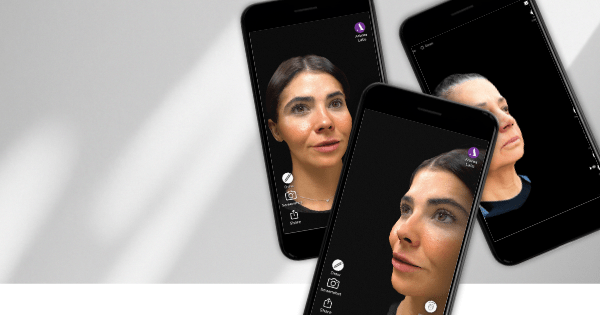
Arbrea’s augmented reality preview places the projected outcome directly onto the patient’s body in real time, during the consultation, using only an iPhone or iPad. For a patient requesting a natural result, this is not a convenience — it is the only reliable way to close the expectation gap before surgery.
The AR preview operates from the patient’s own physical parameters. The simulation is not a generic approximation or a scaled version of another patient’s result. It is built from the measurements taken in that consultation room, from that patient’s existing anatomy. When a surgeon adjusts volume, profile, or placement in the AR preview, the patient sees the change on their own body immediately, not on a model, not on a composite image, but on themselves.
For patients requesting subtle outcomes, this specificity is what makes the difference between a patient who leaves with a clear picture of what they are agreeing to and one who leaves with a verbal reassurance they cannot fully visualize. The surgeon and patient align on a specific, realistic result before any commitment is made. The expectation formed in that consultation is grounded in something the patient has actually seen on their own anatomy, in their own proportions.
The revision cases most likely to follow the natural result trend are not failures of surgical skill. They are failures of preoperative alignment. The patient expected something specific that they could never fully picture from the consultation, and what they saw in recovery differed from the image they had constructed mentally. Arbrea AR closes that gap at the point where it forms.
Source: Arbrea Labs, “New Clinical Evidence Confirms: Arbrea Achieves 100% Surgical Accuracy and High Conversion Rates in Virtual Consultations,” Plastic & Reconstructive Surgery – Global Open, November 2025
Where the market is going and what it requires
The data on patient demand points in one direction. The aesthetic preferences driving procedure requests are not returning to where they were. Practices that adapted their consultation tools for the high-volume relying on “before-and-after” galleries, verbal outcome descriptions, and printed reference images are working with instruments designed for a patient who is increasingly rare.
The consultation that serves the current patient is one where the surgeon can show a precise, patient-specific result during the appointment. Not describe it. Not reference someone else’s outcome. Show it, on this patient’s body, with this patient’s anatomy, at the volume and profile being discussed.
That is what Arbrea AR makes possible. And as the data on implant preferences continues to move in the direction it has been moving, the practices that can offer that consultation are better positioned not just for conversion rates, but for the postoperative satisfaction scores that determine whether a patient refers others or requests a revision.
Sources: International Society of Aesthetic Plastic Surgery (ISAPS), Global Statistics on Aesthetic/Cosmetic Procedures, 2023. · American Society of Plastic Surgeons (ASPS), Plastic Surgery Statistics Report, 2023. · Arbrea Labs multi-site clinical observations, 2025.
Related reading: The 5-Minute Consultation Problem: Why Speed of Visualization Converts More Patients
Book a Demo Now





 EN
EN  PT
PT  IT
IT  ES
ES  DE
DE