

A patient walks in about the thing she’s been thinking about for four years. Her nose. Her breasts. The stomach that never went back after two children. The consultation goes well. You agree on what bothers her, she asks good questions, you explain the options. She leaves saying she needs to talk to her husband.
She never books.
Your instinct will be that you need more enquiries. But she wasn’t a traffic problem. She was a conversion problem and conversion is the cheaper thing to fix.
Do the maths on your own clinic first
40 consultations a month at 30% conversion is 12 cases. Lift that to 50% and you get 20, from identical spend and identical hours. To find those 8 extra cases through advertising instead, you’d need 27 more consultations through the door. (Illustrative figures, run them with your own.)
New clinics lose more revenue between consultation and booking than at the top of the funnel. And the leak is widest exactly where your best cases are: high price, permanent result, long deliberation, and a patient who is genuinely afraid of not looking like herself afterwards.
Stop asking her to imagine the result
A standard consultation asks a lot. You describe the plan in clinical language, show her photographs of other people’s faces or bodies, then ask her to commit to surgery, two weeks off work and serious money based on a picture she has assembled in her own head.
Most patients can’t do that. And the ones who can’t don’t say “I can’t picture it.” They say “I need to think about it.”
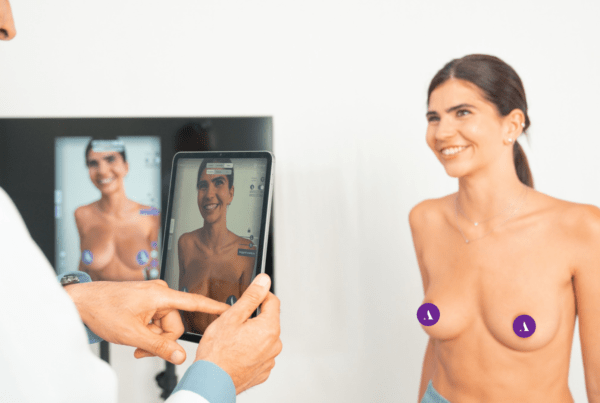
Take rhinoplasty as the example. With Arbrea Face you scan her using the iPad camera in under a minute, no external scanner. AR mode gives her a live, mirror-like view of her own face with the simulated result. What happens next is the commercially important part: she stops listening and starts directing. A little less off the bridge. What if you leave the tip there. You’re no longer selling a procedure, you’re designing an outcome together.
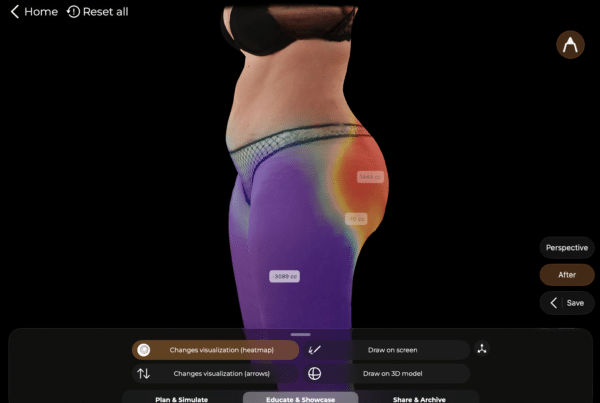
The same shift happens in a breast consultation when she sees the implant size on her own body instead of a catalogue, and in body contouring when the result is on her silhouette rather than a stranger’s.
Measurements matter too. Often the honest answer to “make my nose smaller” is that the chin is under-projected. Showing her that on screen turns a rhinoplasty consultation into a profileplasty conversation, better medicine, and a larger case.
The decision gets made in her home, not your consultation room
She goes home, talks to her husband, compares you against two other clinics. Most practices fill that gap with a price list.
myArbrea sends the simulation to her phone, in an app carrying your logo and colours. When she explains the plan at the kitchen table, she has something to show. When she compares you to the clinic that handed her a brochure, you’re not competing on price. She can revisit it and share it with an organic reach you didn’t pay for. It connects to your existing booking system, so leads land in the funnel you already run.
And before she leaves, agree to a specific follow-up date. Not “let us know.” A date.
Where does your clinic lose the most patients?
Pick the stage that costs you the most cases today.
One vote per reader. Results appear after you vote.
Turning followers into enquiries
Your hardest audience is the one not ready to call. The woman who has wanted a procedure for four years follows three clinics and has contacted none of them, because booking a consultation feels like commitment. Opening an app to see her own result does not.
By the time she does contact you she’s informed, engaged with your brand, and knows roughly what she wants. Pre-qualified leads convert better, no-show less, and consult faster because the exploratory half already happened. In year one, those hours matter.
Two things new owners underestimate
Data. Arbrea doesn’t store patient data. Without a compliance officer or IT team, that removes an entire category of risk and it’s worth saying out loud to nervous patients.
Documentation. Your best marketing asset in eighteen months is the work you’re doing this month. Standardise capture from week one, same angles every time, and take marketing consent as a separate signed item never buried in the treatment consent.
Your first 90 days
- Track two numbers weekly: enquiries, and consultation conversion rate
- Use simulation on every suitable case, not just the hard ones
- Never let a patient leave without the simulation on her phone
- Book the follow-up before she leaves the room
- Standardise capture and marketing consent from case one
- Promote the app socially as a no-commitment first step
- Ask every patient who books how they found you
The short version
New clinics rarely fail on clinical skill or lead volume. They fail in the gap between “this sounds interesting” and “I’m booking.” Close that gap and the rest gets easier.



 English
  Portuguese
  Italian
  Spanish
  German
  Arabic
  French
  Korean
  Albanian
  Thai
Thai  Hindi
Hindi  Vietnamese
  Japanese