

Somewhere in the world, a patient is exploring a personalized 3D simulation of what could be possible and using it to have a more informed conversation with her surgeon before ever stepping into an operating room. It happens more often than you might think.
The numbers behind the moment
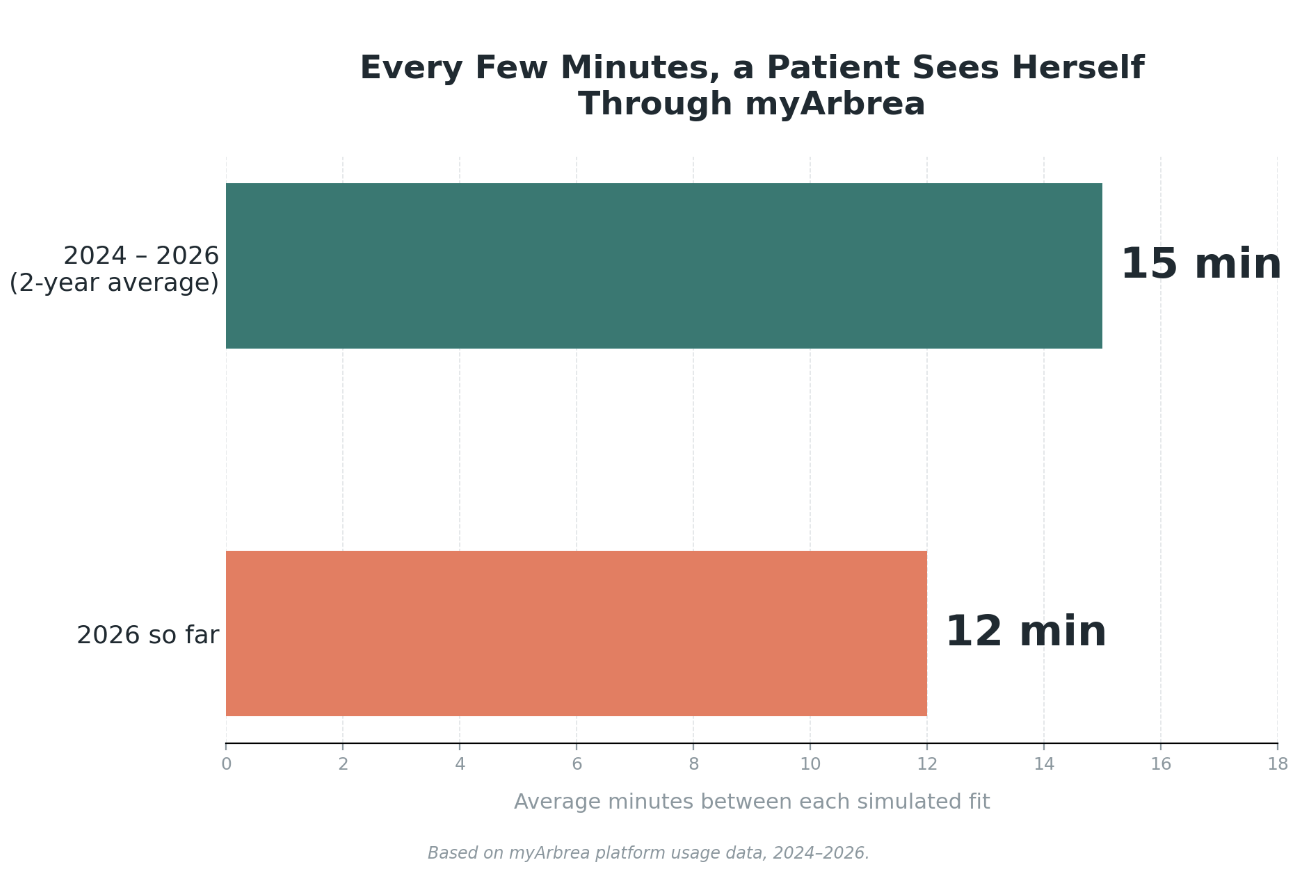
Over the past two years, patients using miÁrbol have created tens of thousands of personalized simulations, or “fits.” Averaged across that period, the result is simple:
A new fit is created every 15 minutes.
Based on miÁrbol usage in 2026 so far:
A new fit is created every 12 minutes.
That is the equivalent of roughly five fits per hour, averaged across every hour of every day and the pace continues to rise as miÁrbol usage grows. Behind those numbers is something much more human.
Why this matters
Behind every fit is a real conversation: a patient trying to feel more confident about a decision, and a surgeon translating clinical expertise into something visual and easier to understand. The growth in usage is not just a statistic. It reflects a simple reality: when patients are considering a procedure, many want more than a verbal explanation. They want a clearer way to explore possibilities, understand their options, and communicate what they have in mind.
That is the gap miÁrbol was built to help close. By turning complex conversations about possible outcomes into clear, personalized 3D visuals, miÁrbol gives patients something concrete to explore and discuss with their surgeon. The result is not simply another image on a screen. It is a better starting point for the conversation.
The clinical rationale
Informed consent is more than a signature. It is a process of helping patients understand a procedure, consider their options, ask questions, and develop realistic expectations. Shared decision-making follows the same principle: patients should be able to engage actively with information rather than simply receive it.
Personalized visualization can support that process. Instead of relying only on verbal descriptions or generic before-and-after photos of other patients, a patient can explore a simulation based on their own body or face. This gives them something specific to react to, question, compare, and discuss.
They may realize that they prefer one shape over another. They may discover that what they originally imagined is different from what they actually like when they see it. They may arrive at the next consultation with clearer preferences and more focused questions. For the surgeon, this can create a more concrete starting point for discussion. The simulation is not a prediction or guarantee of an exact surgical result. Its role is to support exploration, communication, and a clearer understanding of the patient’s preferences before a decision is made.
How the simulation works
miÁrbol is designed for the patient.
Using a personal code provided by their doctor, patients can access miÁrbol and create breast or face simulations from their own phone. They can explore different shapes and options at their own pace, outside the time constraints of a consultation appointment.
This gives patients space to reflect. They can return to the simulation later. Compare different fits. Think through their preferences without feeling rushed. And prepare more specific questions for their surgeon. Once they have explored their options, patients can share their simulations directly with their surgeon through Suite Arbrea.
The surgeon can then review exactly what the patient explored and use those simulations as a starting point for the next conversation. Patients can also export a fit to discuss privately with people they trust before making a decision.
- The patient explores.
- The surgeon reviews.
- The conversation continues with greater clarity.
This two-way connection helps keep both sides aligned before the procedure, while fitting naturally into the consultation journey.
What this means for your practice
For surgeons and clinics, this trend is more than an interesting number. It points to a broader shift in the consultation experience.
Patients increasingly expect information to be visual, personalized, and accessible. They are used to exploring options digitally, revisiting information in their own time, and arriving at important decisions with a clearer sense of what they want to discuss.
A surgical consultation is different from any other decision, of course. But the expectation for clarity does not disappear simply because the decision is complex. miÁrbol brings personalized visualization directly into that journey. It allows patients to explore possible options from their own phone before surgery and gives surgeons a clearer understanding of what the patient has been considering.
For a practice, that can help:
- Help patients feel more informed and prepared
- Create a more concrete starting point for discussions about expectations
- Reduce repeated explanations by allowing patients to revisit their simulations in their own time
The goal is not to replace the surgeon’s expertise. It is to make that expertise easier to communicate.
Across the previous two years, a new miÁrbol fit was created, on average, every 15 minutes.
In 2026 so far, that interval has shortened to 12 minutes. Every one of those fits represents a moment of exploration: a patient considering possibilities, developing questions, and preparing for a more informed conversation about what comes next.






 EN
EN  PT
PT  IT
IT  ES
ES  DE
DE