

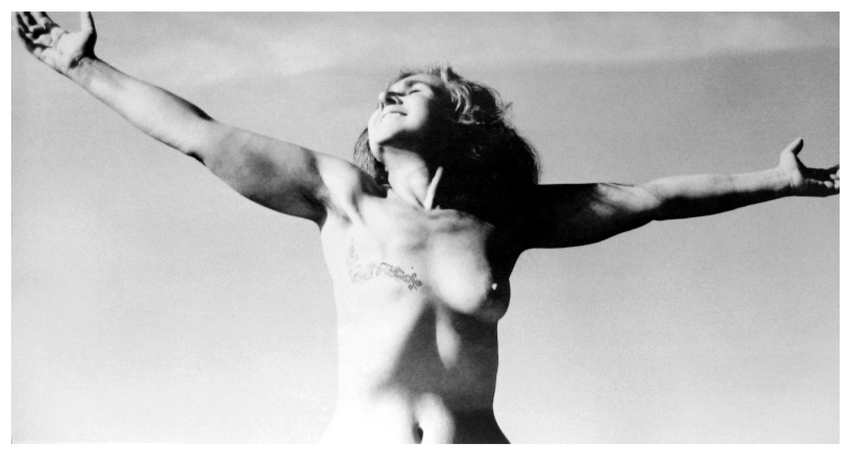
A photograph, 1977
A woman stands outdoors, bare-chested, her arms raised wide toward the sky. On one side of her chest is a breast. On the other is a mastectomy scar, and across it, a tattooed branch.
The photograph was taken in 1977 by Hella Hammid. The woman is the poet and novelist Deena Metzger. Reproduced as a poster under the title The Warrior, it travelled far beyond the circles that first shared it, and it is still one of the most widely recognised images of life after breast cancer.
Nearly fifty years later, it remains a useful starting point for a question that every October tends to blur: what does it mean for a woman to choose what her body looks like after surgery?
Deena Metzger: refusing to hide
Metzger did not make the photograph as a statement against surgery. She had undergone a mastectomy and was living with its consequences. What she refused was the expectation that those consequences should be kept out of sight.
Deena Metzger, The Warrior, photograph by Hella Hammid, 1977. Courtesy of Deena Metzger and the Estate of Hella Hammid.
The poster carried a short poem of hers. In it, she writes that she is no longer afraid of mirrors, and she describes the place where her breast had been not as an absence but as the site of a new kind of strength. The tattoo turns the scar into something deliberately marked rather than concealed.
The gesture is simple and, for its time, radical. In the late 1970s, the standard expectation was that a woman would return from surgery and resume her life as if nothing visible had changed. Metzger’s raised arms said something else: that the body after cancer could be shown, on her own terms, and that showing it was a form of authorship rather than exposure.
Audre Lorde: the prosthesis and the silence
In 1978 the poet Audre Lorde was diagnosed with breast cancer and had a mastectomy. Two years later she published The Cancer Journals, a book that combines diary entries with essays and remains one of the most cited texts on the subject.
Lorde decided not to wear a prosthesis. She recounts a visit to her surgeon’s office in which a nurse told her that coming in without one was bad for the morale of the office. The episode, small in itself, becomes the centre of her argument.
For Lorde, the prosthesis was not just an object. It was the sign of an expectation: that a woman who had lost a breast should look exactly as she had before, so that no one would need to notice. The cost of that expectation, she argued, was isolation. If every woman who had had a mastectomy looked as if nothing had happened, women in the same situation could not recognise one another, share what they knew, or speak openly about what they had been through.
Lorde did not claim that her choice was the right one for everyone. Her claim was narrower and more durable: the decision about how a body looks after cancer belongs to the woman, and it should never be made for her by the comfort of others.
The trouble with the word “warrior”
In 1978, the same year as Lorde’s diagnosis, Susan Sontag published Illness as Metaphor. Sontag had herself been treated for breast cancer a few years earlier. Her essay argued that the metaphors we attach to illness, including the language of war, invasion and battle, are not harmless. They load patients with meanings they did not choose, and they can quietly suggest that those who do not recover simply did not fight hard enough.
This puts Metzger’s poster and Lorde’s book in an interesting light. Both women embraced the image of the warrior. Yet neither used it to describe a battle against a disease that could be won by will alone. Their warrior was someone who refused to be made invisible: a figure of presence, not of victory.
The distinction still matters. Much of October’s language speaks of fighters and survivors, of battles won and lost. Sontag’s warning, read alongside Metzger and Lorde, suggests a more careful vocabulary. Courage is real, but it is not the same as recovery, and dignity does not depend on the outcome.
Choice, in practice
The options available to a woman after mastectomy today are far wider than in 1977. Implant-based reconstruction, autologous flap techniques, oncoplastic approaches and aesthetic flat closure are all part of the clinical conversation. Some women choose reconstruction immediately, some later, some not at all.
The legacy of Metzger and Lorde is not a preference for one of these paths. It is the principle that the path should be chosen by the patient, fully informed, without pressure from what others expect a woman’s body to look like. That principle applies in both directions: reconstruction should never be presented as an obligation, and choosing it should never be read as a lack of courage.
In practice, this choice is made, or lost, in the consultation. It depends on time, on clear explanations, and on whether a patient can truly picture what each option would mean for her. Realistic three-dimensional visualisation can help here, if it is used to inform rather than to persuade. A patient who can see the possible outcomes, and discuss them openly with her surgeon, is in a better position to decide what she wants, including the decision not to reconstruct.
Where Arbrea stands
Arbrea Labs was built on a simple idea: a decision about one’s own body is easier to make when it can be seen. Today Arbrea’s 3D simulations are used by surgeons in more than 60 countries, in both aesthetic surgery and breast reconstruction.
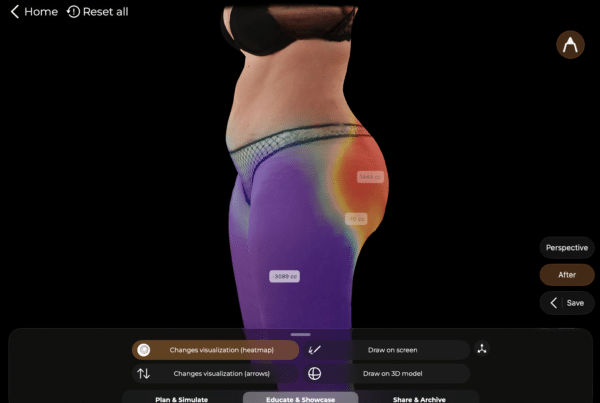
In the consultation, Arbrea Suite lets surgeon and patient look together at possible results on the patient’s own body, not on a catalogue photo. With myArbrea, the patient can then revisit the simulation at home, in her own time, and return to the next appointment with her own questions.
We believe these tools only make sense within the principle Metzger and Lorde defended. A simulation is not a promise, and it does not replace clinical judgement. It is a support for the conversation, there to make the choice clearer, whatever that choice turns out to be.
Arms open
The image of a woman with her arms raised is easy to turn into a slogan. Metzger’s photograph resists that. It does not tell other women what to do; it shows one woman doing what she had decided for herself.
That may be the most useful thing to carry into October. Awareness matters, but awareness is not the same as choice. The real measure of progress is whether every patient leaves the consultation room knowing that the decision about her body is, and remains, her own.
Sources
- Deena Metzger, The Warrior, poster with photograph by Hella Hammid, 1977.
- Audre Lorde, The Cancer Journals, San Francisco: Spinsters Ink, 1980.
- Susan Sontag, Illness as Metaphor, New York: Farrar, Straus and Giroux, 1978.





 English
  Portuguese
  Italian
  Spanish
  German
  Arabic
  French
  Korean
  Albanian
  Thai
Thai  Hindi
Hindi  Vietnamese
  Japanese